

Types of Tapered Conveyor Rollers
LEEV manufactures multiple tapered conveyor roller structures for different curve conveyor systems, load capacities, and drive methods. Roller materials, surface treatments, and drive configurations can be customized based on conveyor layout requirements.

Steel Tapered Conveyor Rollers
Suitable for heavy-duty and powered curve conveyor systems. Available with sprocket drive, poly-V drive, and double O-belt configurations for warehouse and logistics conveying applications.

PVC Sleeve Tapered Rollers
PVC sleeve tapered rollers provide lower noise and improved product protection during curve conveying. Commonly used in light-duty parcel handling and e-commerce logistics systems.

Stainless Steel Tapered Rollers
Designed for wet or corrosion-sensitive conveying environments. Stainless steel tapered rollers are widely used in food processing, pharmaceutical, and clean conveying systems.
Drive Configurations for Tapered Rollers
Different drive configurations can be used on tapered conveyor rollers depending on conveyor layout, load capacity, conveying speed, and transmission requirements.
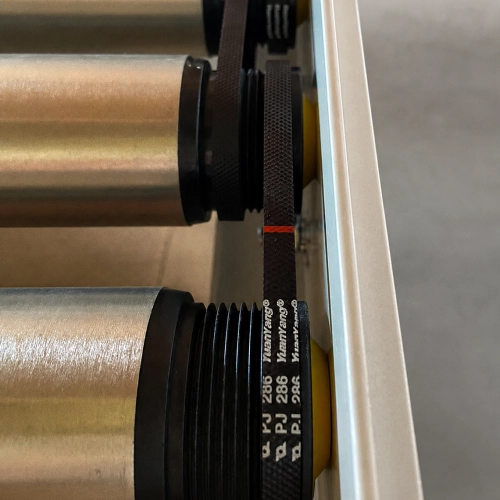
Poly-V Drive Tapered Rollers
Commonly used in high-speed parcel handling and low-noise logistics conveyor systems requiring smooth and stable conveying performance.
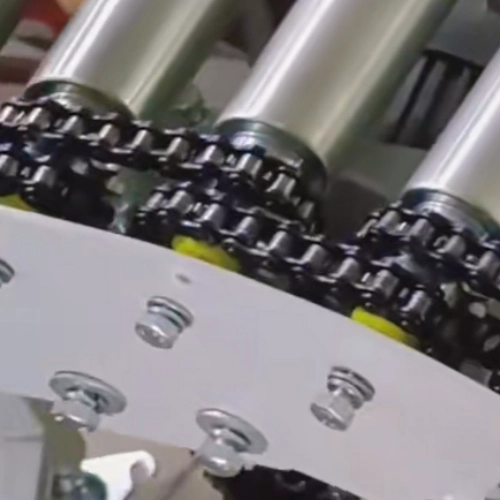
Sprocket Drive Tapered Rollers
Suitable for powered curve conveyors requiring stable chain transmission and higher load capacity in industrial conveying applications.
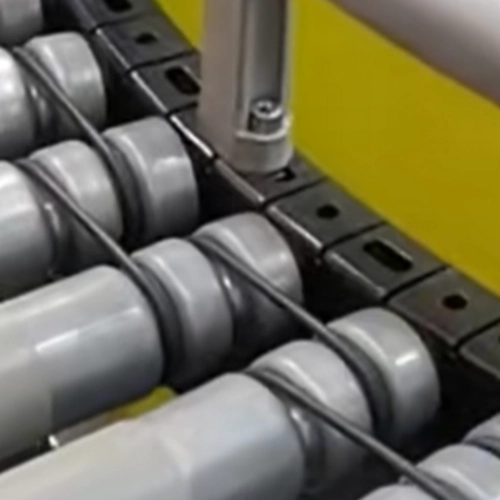
Double O-Belt Tapered Rollers
Often used in light-duty carton conveying and flexible accumulation conveyor layouts for logistics and e-commerce handling systems.
Engineering Considerations for Tapered Conveyor Rollers
PVC sleeve tapered rollers are commonly made by assembling tapered PVC sleeves onto straight steel rollers, rather than manufacturing the entire roller body as one tapered steel tube.
PVC tapered sleeves are commonly produced in standard segmented sections, with each section typically around 100 mm (3.94″) long and based on a standard taper angle such as 3.6°. Different sleeve lengths can be achieved by combining different numbers of sleeve sections according to conveyor width and product dimensions.
Since PVC tapered sleeves are mold-produced parts, special taper angles usually require new tooling, which increases mold cost and minimum order requirements.
In many applications, the tapered sleeve does not need to completely cover the full roller width. As long as most of the product contact area is supported by the tapered section, stable curve conveying performance can usually be achieved.
For example, if the roller face width is 820 mm (32.3″) and the conveyed product width is around 800 mm (31.5″), a small uncovered straight section usually does not affect normal conveying performance. This can help avoid unnecessary custom machining or special mold costs.
If full tapered coverage is required for a special conveyor layout, additional machining can be used to reduce the diameter near the roller end. However, from a practical manufacturing perspective, complete coverage is not always necessary for every project.
Steel tapered conveyor rollers are different. They are normally manufactured directly from tapered steel tubes with welded bearing housings, allowing more flexible taper customization for powered or heavier-duty curve conveyor systems.
For steel tapered rollers, confirming the large-end diameter and small-end diameter is often more practical than providing only a taper angle. Actual roller diameters are easier to verify during production and dimensional inspection, which makes project confirmation and quality control more straightforward.
PVC Sleeve Assembly Comparison
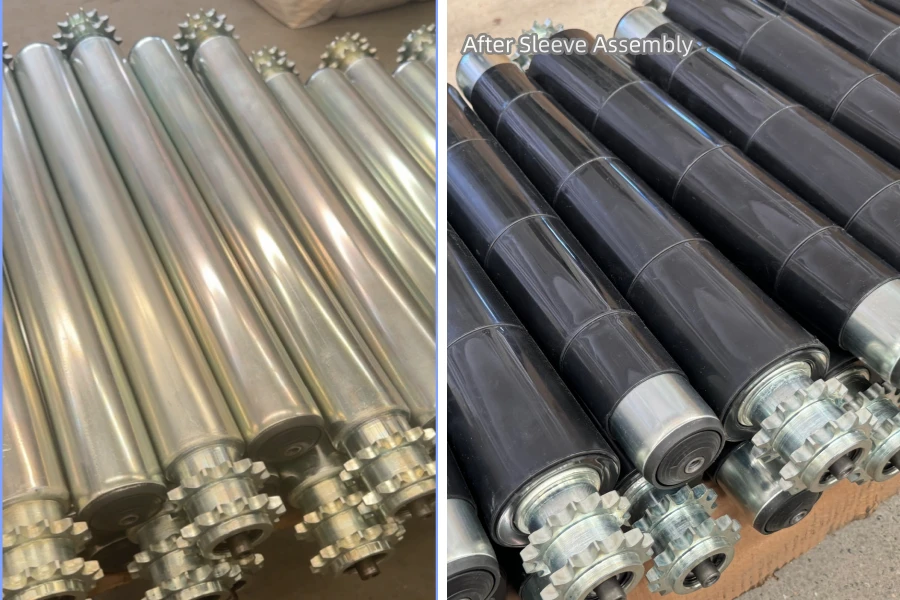
Comparison of sprocket driven conveyor rollers before and after PVC tapered sleeve assembly, showing the straight steel roller core and segmented PVC sleeve structure used for curve conveyor systems.
Manufacturing Details of Tapered Conveyor Rollers
Unlike standard straight rollers, steel tapered conveyor rollers are typically manufactured by forming steel plates into tapered tubes before welding bearing housings and assembling shafts or drive structures.
This manufacturing structure is commonly used for powered curve conveyor systems requiring higher rigidity and stable transmission performance.
For PVC sleeve tapered rollers, segmented PVC sleeves are assembled onto standard 50 mm (1.97″) straight rollers to create the required tapered conveying surface for curve conveyor applications.
Semi-finished tapered steel tubes and PVC sleeve assembly processes shown above are from our actual tapered conveyor roller production. We pay attention to manufacturing details such as assembly consistency, roller runout control, and dimensional inspection throughout production.
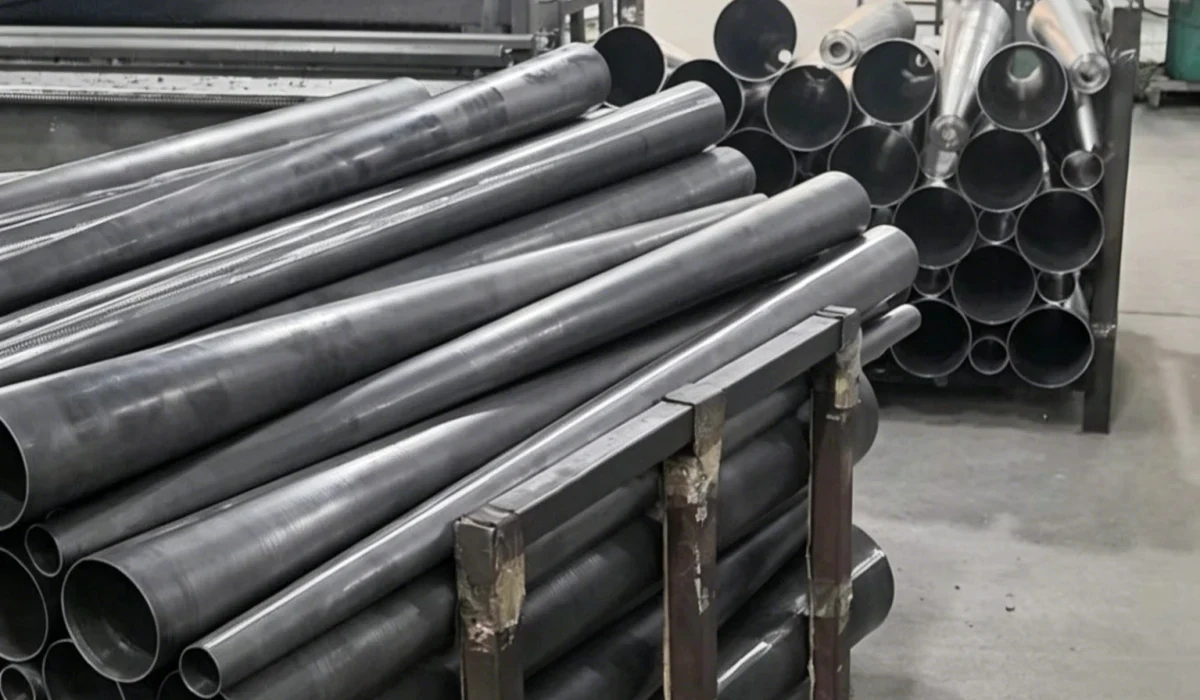
Semi-finished tapered steel tubes prepared for welded tapered conveyor roller manufacturing and assembly in industrial conveyor systems.
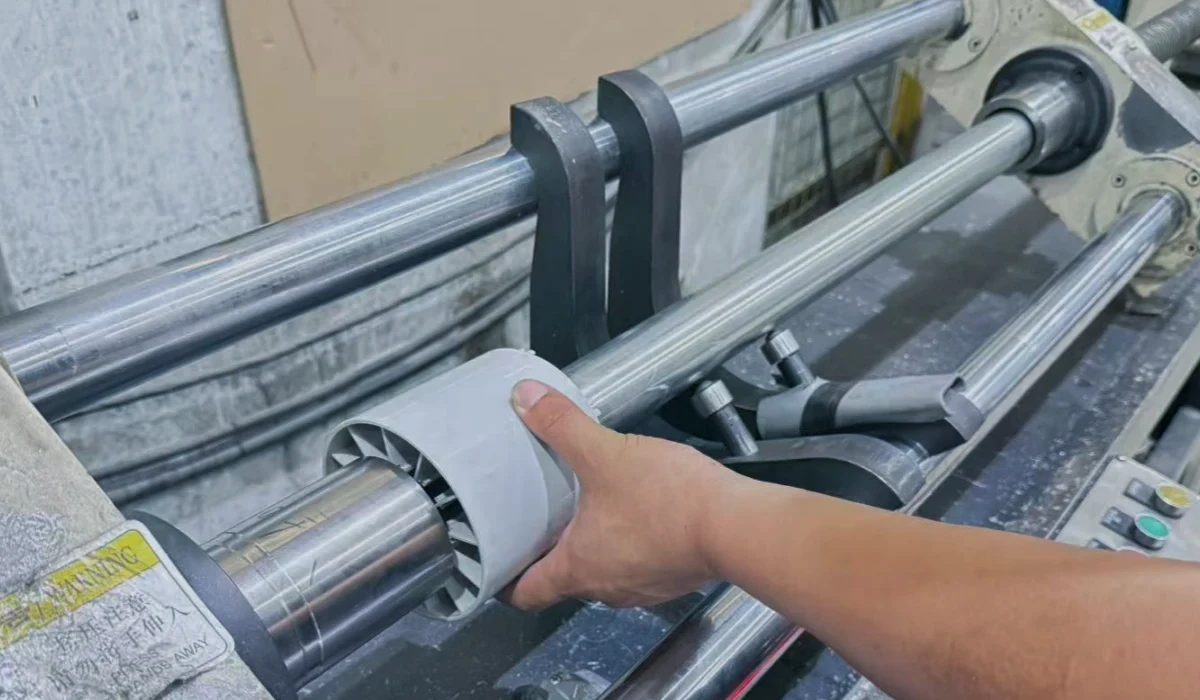
Assembly process of segmented PVC tapered sleeves installed onto conveyor rollers for curve conveyor systems.


Tapered Rollers in This Category
Representative tapered conveyor rollers from our production line. The taper keeps product aligned through curved conveyor sections.
Explore More
- Engineering guide: how to size conveyor rollers.
- Where they run: tapered rollers on curved sections of sortation & warehouse lines.
- Not sure which type fits? Compare all conveyor roller types in our selection guide.


