


Laser welding process for stainless steel conveyor roller flange structures.
Stainless Steel Surface and Corrosion Details
For stainless steel conveyor rollers, surface finish and welding quality are important for clean appearance, assembly accuracy, and long-term use in moisture exposed environments.
Laser Welding
Compared with traditional gas shielded welding, laser welding can provide cleaner and more visually refined weld seams for stainless steel conveyor rollers.
Smooth Stainless Steel Surfaces
Polished or smooth surfaces help improve product appearance and make the roller easier to clean.
Corrosion Sensitive Environments
Material and surface details can be selected according to moisture, cleaning, and corrosion requirements.
Different stainless steel conveyor roller structures and surface details can be selected according to conveyor environments and cleaning requirements.
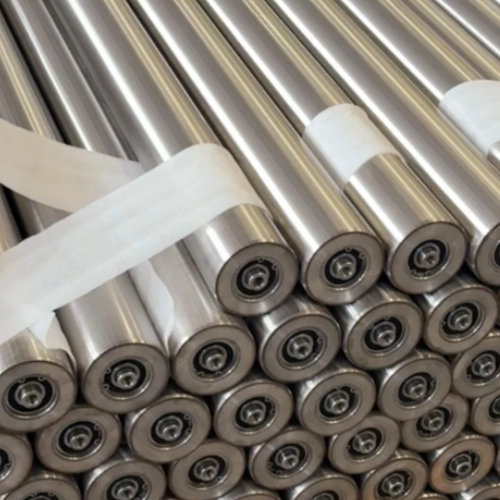
Polished Stainless Steel Gravity Rollers
Smooth stainless steel surfaces for cleaner and moisture exposed conveyor environments.
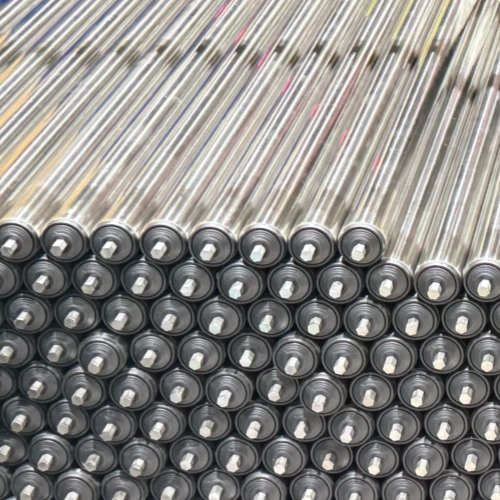
Stainless Steel Rollers with Plastic End Caps
Plastic end cap structures can help reduce noise and improve corrosion resistance in humid conveyor environments.
What a "Stainless Steel Conveyor Roller" Actually Means
A "stainless steel conveyor roller" rarely means every part is stainless. Full-stainless construction is expensive and often unnecessary, so most customers specify stainless only where it contacts the product or the washdown environment — usually the tube — and keep cost down on the rest: a stainless tube with bearing-steel bearings, a steel shaft, and plastic end caps. This puts corrosion resistance where it matters at a far better price.
Sprocket rollers are a good example: many are built with a stainless tube but a steel sprocket. Steel is cheaper, and a hardened (quenched) steel sprocket is harder and wears better than stainless. Because buyers often call any roller with a stainless tube a "stainless roller," we always confirm which parts are stainless and which stay steel or plastic before quoting — these choices drive large cost differences.
Stainless Steel 304 Tube Sizes
| Tube OD | Wall thickness (mm) |
|---|---|
| Ø25 mm (0.98″) | 1.0, 2.0 |
| Ø32 mm (1.26″) | 1.0, 1.5 |
| Ø38 mm (1.50″) | 1.2, 1.5, 2.0 |
| Ø42 mm (1.65″) | 1.5 |
| Ø50 mm (1.97″) | 1.2, 1.5, 2.0, 3.0 |
| Ø60 mm (2.36″) | 1.2, 1.5, 2.0, 2.5, 3.0 |
| Ø63 mm (2.48″) | 2.0, 2.5 |
| Ø76 mm (2.99″) | 1.5, 2.0, 2.5, 3.0 |
| Ø89 mm (3.50″) | 2.5, 3.0 |
Shaft options include Ø11 mm hex (7/16″), and Ø12, Ø15, and Ø20 mm round shafts. Other diameters and grades (including 316) are available on request.


Stainless Steel Rollers in This Category
Representative stainless steel conveyor rollers from our production line. Built in SS304 for wet, cold-chain and sanitary environments.
Explore More
- Engineering guides: sealed bearings for washdown duty and corrosion resistance & service life.
- Where they run: stainless rollers on cold-chain & sanitary lines.
- Not sure which type fits? Compare all conveyor roller types in our selection guide.


