Gravity Conveyor Roller Manufacturer | Engineering-Driven Custom Solutions

๐Ÿš€ Engineering-Driven Manufacturing
Specializing in complex conveyor solution design and high-precision manufacturing.

๐Ÿญ 100% Run-Out Testing
Precision Standard: โ‰ค0.5mm/m factory-wide roller run-out inspection.

โš™๏ธ Versatile Mounting Configurations
Full support for Metric/Imperial Hex, Threaded, Milled, and Spring-loaded shaft ends.

๐ŸŒก๏ธ Extreme Condition Optimization
Engineered to withstand temperatures from โˆ’30ยฐC to 120ยฐC as standard โ€” cold-chain (โˆ’50ยฐC), high-temp (180ยฐC) and 200 kg+ welded-housing builds available on request.

50mm Diameter Steel Zinc-Plated Gravity Conveyor Roller

Types of Gravity Conveyor Rollers

25mm stainless steel gravity conveyor rollers with yellow plastic end caps

ร˜25mm Stainless Steel Roller

Constructed with stainless steel tubes and plastic end caps, commonly used in light duty conveying systems and corrosion resistant environments.

38mm zinc plated conveyor rollers with raised bearing housing in factory production

ร˜38mm Zinc Plated Roller

Zinc plated gravity rollers with internal threaded shaft structure for stable installation and general conveying applications.

1.9 inch gravity conveyor rollers with spring loaded shaft design

1.9" Spring Loaded Roller

1.9 inch diameter gravity rollers with spring loaded shaft design for quick installation in North American conveyor systems.

2 inch zinc plated gravity conveyor rollers with external threaded shafts

2" External Thread Roller

External threaded shaft structure with locking nuts for more secure installation in heavy duty conveyor frames.

Gravity Conveyor Roller Applications

Gravity conveyor rollers are widely used in non-powered conveying sections, buffer zones, sorting lines, and manual transfer areas where products need smooth and stable movement.
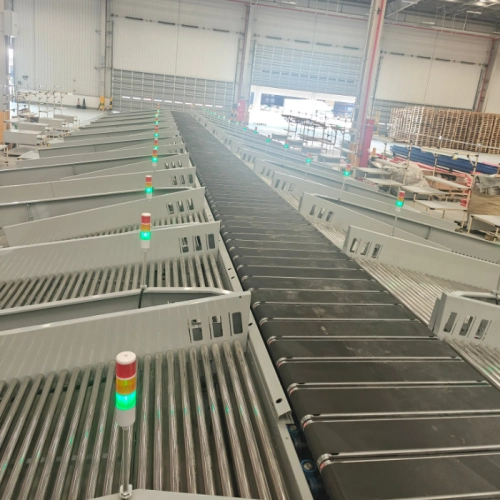
roller conveyor line used for express parcel sorting operations

Express Parcel Sorting Line

Used at the tail end of express parcel sorting lines for package collection, buffering, and manual handling after sorting.
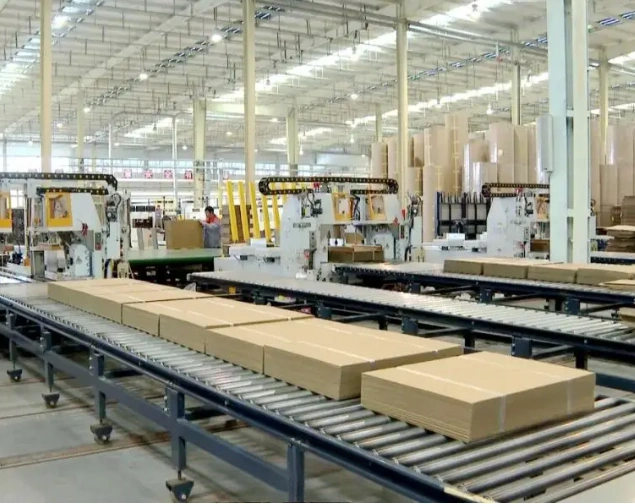
gravity roller conveyor line used in corrugated cardboard production line

Corrugated Cardboard Production Line

Used for transferring corrugated cardboard sheets during cardboard production and packaging material handling processes.
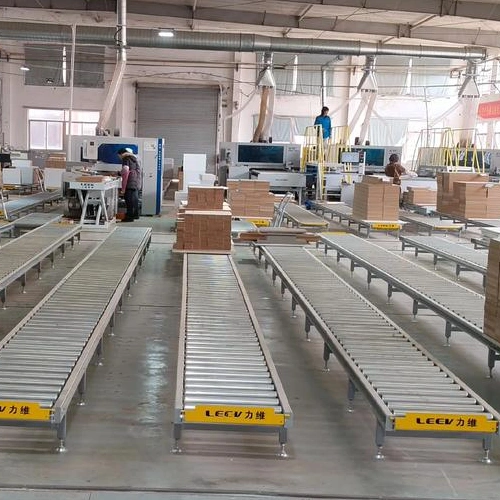
gravity roller conveyor line used for furniture board buffering and manual transfer

Furniture Board Buffering Area

Used in furniture board factories for panel buffering, temporary storage, and manual transfer between production steps.

Products Categories
Get A Free Quote
Send Your Drawing or Requirements

Industry Applications & Field Logic

Gravity rollers are the backbone of efficient, low-cost material flow in non-powered logistics. We provide tailored solutions for diverse sectors:

  • Logistics & Warehousing: Optimized for warehouse flow racks, carton handling, and order picking systems.
  • Industrial Manufacturing: Widely used in assembly workstations and temporary buffer zones to regulate production pace.
  • Food & Pharmaceutical: Utilizing stainless steel materials and specialized sealing to meet high hygiene and anti-corrosion standards.
  • System Layout Adaptability: We provide standard cylindrical rollers for straight sections and Tapered Rollers for curved sections to ensure stable, centered movement during direction changes.
Polished Zinc-Plated 48mm Diameter External-Thread Gravity Roller
60mm Diameter Internal-Thread Zinc-Plated Gravity Roller
50mm Diameter Plastic End Cap Gravity Roller
Steel Conveyor Roller - Diameter 38mm, Built-in Spring
50mm Diameter Galvanized Internal Thread Gravity Roller
50mm Diameter Steel Zinc-Plated Gravity Conveyor Roller

Global Material Standards & Reliable Traceability

We utilize high-grade raw materials and provide clear international standard equivalents to meet the rigorous selection requirements of global engineers.

Component Chinese Grade (GB) US (ASTM/AISI) Germany (DIN/EN) Japan (JIS) LEEV Engineering Advantage
Carbon Steel Tube Q235B ASTM A36 S235JR SS400 Superior weldability and structural stability.
Precision Shaft 45# / Q235 AISI 1045 / A36 C45 / S235JR S45C / SS400 Flexible material selection to balance strength and cost.
Stainless Steel SS304 AISI 304 1.4301 SUS304 100% material analysis for cold chain and sanitary safety.
  • ISO 9001:2015 Certified Factory: All gravity rollers are produced under our ISO 9001:2015 quality management system (certificate no. 04625Q13002R2S).
  • Advanced Quality Control: Every batch of Zinc Plated rollers undergoes zinc layer thickness testing to verify corrosion resistance.
  • Precision Run-out Control: Every roller is subjected to 100% run-out testing before leaving the factory, maintaining a standard tolerance of โ‰ค 0.5mm per meter. For applications requiring extreme precision, we offer tighter run-out customization, though this may increase production lead times and costs.

Gravity Rollers in This Category

Representative gravity conveyor rollers from our production line. Tube diameter, wall thickness, shaft and mounting are all built to your drawing — the units below show the range.

Explore More

Engineering FAQ

Q: When should I choose welded bearing housings over standard pressed housings?

A: When the load per roller exceeds 200kg or the system is subject to frequent impact loads, steel welded bearing housings are the necessary choice. The welded structure eliminates the risk of end caps popping out under stress and offers superior mechanical integrity compared to pressed versions.

Q: What is the difference between PVC sleeve rollers and standard zinc-plated rollers?

A: Standard zinc-plated rollers are used for general logistics. PVC Sleeve Coating is specifically applied to protect high-value materials (such as furniture boards or polished panels) from scratches. Additionally, the sleeve provides significant vibration dampening and noise reduction.

Q: Can you manufacture rollers based on specific technical drawings?

A: Yes. As a Professional Conveyor Roller Manufacturer, we specialize in OEM contract manufacturing and can process PDF, DWG, or STEP files with engineering feedback provided within 24 hours.

Q: What is a gravity conveyor roller and how does it work?

A: A gravity conveyor roller is an unpowered tube that spins freely on sealed ball bearings seated in both ends, with no motor, chain, or belt. Loads move when an operator pushes them or when the rollers sit on a slight decline so gravity does the work; the rollers simply reduce friction so the package keeps traveling. Arranged in rows within a frame, these rollers form a gravity roller conveyor used for accumulation, sorting buffers, and manual transfer. LEEV manufactures the rollers themselves, not the complete conveyor.

Q: What is the difference between light-duty and heavy-duty gravity rollers?

A: The difference is mainly tube diameter and wall thickness, sized to the load per roller. Light-duty rollers use smaller tubes around ร˜38โ€“ร˜50 mm (1.5″โ€“1.97″) for loads under roughly 20 kg, while medium and heavy duty step up through ร˜50โ€“ร˜60 mm and ร˜60โ€“ร˜76 mm (2.36″โ€“3.0″) as loads rise. Extra-heavy duty above ~200 kg per roller moves to ร˜89โ€“ร˜108 mm (3.5″โ€“4.25″) tube โ€” the point at which we also switch from pressed to welded bearing housings (see our housing FAQ for why).

Comprehensive Specifications & Mounting Options

  • Roller Diameters:
    Metric tubes from ร˜25 mm to ร˜108 mm, plus exact imperial tubes for North-American specs. We hold the true 1.9″ tube at ร˜48.26 mm โ€” not a nominal ร˜50 mm substitute โ€” so replacement rollers fit existing 1.9″ conveyor frames. All tube and shaft diameters can be fully customized to your technical drawings.
  • Internal Thread Installation:
    Provides a flush finish and high structural stability.
  • External Thread Installation:
    Ideal for secure fastening with nuts under heavy load.
  • Spring-Loaded Shafts:
    Designed for rapid installation. Supports 7/16″ and 11/16″ hex sizes.
  • Milled Flat Shaft Ends:
    Used for orientation within frame slots to prevent axial rotation.
  • Semi-Circular Ends / Pin-Hole Mounting:
    Specialized options for custom industrial frames.
Nominal size Our tube outside diameter Series
1.9″ ร˜48.26 mm Exact imperial
1.97″ ร˜50 mm Metric
2.5″ ร˜63.5 mm Exact imperial
3.5″ ร˜89 mm Heavy-duty

Other diameters โ€” including 1-3/8″ (ร˜34.9 mm) and the full ร˜25โ€“ร˜108 mm metric range โ€” are available made-to-order.

Bulk Replacement Rollers for Existing Gravity Roller Conveyors

We supply replacement gravity rollers the way a factory does โ€” by the batch, built to your sample or drawing โ€” for distributors restocking, OEMs, and operations re-rollering a worn line or section. For one or two emergency spares a local supplier will be faster; where we win is matched specs and factory-direct pricing across a full line or a repeat order.

When rollers on a line start to seize, flat-spot, or lose bearings, it pays to replace the whole roller, not just the bearing. A bearing rarely fails overnight, so by the time one runs rough or seizes it has been wearing for a while โ€” and as it wears, its fit in the seat loosens and the bearing seat in the tube end is usually worn too. A fresh bearing pressed into a worn seat still won’t run true, so the reliable fix is complete new rollers. A gravity roller is one pre-assembled unit โ€” tube, bearings, and shaft built together as a sealed assembly, not separate parts โ€” so there is nothing in the old rollers to reuse; you re-roller the run with matching units and the frame stays as it is.

The risk in replacement buying is a unit that looks close but isn’t exact. Get the tube outside diameter wrong and the roller still bolts in โ€” but its surface sits higher or lower than the rollers around it; a ร˜50 mm (1.97″) metric tube dropped into a line built on true 1.9″ (ร˜48.26 mm) tube, for instance, stands almost 1 mm proud, so every load takes a small step as it crosses that roller. Whether the roller installs cleanly comes down to the installation dimension โ€” the mounting length that has to suit the frame for the end type, not a single overall shaft length. An internal-thread roller sits between the two frame channels and is bolted in from the outside through the side holes, so its body length has to match the inside frame width; a spring-loaded roller’s axle tips compress to drop it in and then spring out through those same holes, so it is the length over the extended tips that has to be right. Both end types fit the same frame when built correctly, but they don’t behave alike โ€” spring-loaded ends carry more axial float so they fit quickly, while internal-thread ends sit tighter and more located โ€” so matching the original keeps the replacement running under the same conditions.

An exact diameter is still only one piece of this โ€” a true 1.9″ is ร˜48.26 mm, but that says nothing about the roller face length, the installation dimension, the wall thickness, or the mounting method. A quick tape measurement on the line is easy to get slightly off, so the dependable references are the original drawing โ€” where it carries the actual dimensions, it often tells us everything we need โ€” or a worn roller sent in as a physical sample, and either one lets us copy the roller exactly across the batch. Before anything goes into production, we return a manufacturing drawing for your sign-off, so both sides have confirmed every dimension before we cut any metal โ€” no batch built to the wrong size.

  • Tube outside diameter (and wall thickness) โ€” the OD sets where the roller’s surface sits relative to its neighbors, so it has to match the rest of the line: a true 1.9″ tube is ร˜48.26 mm, 2.5″ is ร˜63.5 mm, and 3.5″ is ร˜89 mm, and none of these is interchangeable with the ร˜50 mm (1.97″) metric tube โ€” mixing them leaves a step that makes loads bounce. Wall thickness sets the load rating, so confirm it if the line runs heavy.
  • Roller face length โ€” the usable carrying length of the tube, the surface that actually moves your product. Match it so the replacement gives the same effective conveying width as the rollers it runs alongside; this is about how the line works for you, separate from how the roller mounts.
  • Between-frame width and mounting method โ€” give us the inside width between the side channels and how the roller mounts: spring-loaded (hex 7/16″, 11/16″), internal thread, external thread with nuts, milled flat, or semi-circular / pin-hole. Together these fix the installation dimension, which differs by end type โ€” for the same frame, a threaded end (bolted in between the channels) and a spring end (tips pushing out through the side holes) need different lengths. Both install when built right, but they don’t behave the same: spring-loaded ends allow more axial float for quick fitting, internal-thread ends sit tighter and more located, so match the original to keep the same running conditions.
  • Quantity, finish, and operating environment โ€” give us the batch or line quantity and any duty or environment requirement, such as stainless or a PVC sleeve for food, pharma, or wet zones, so the replacement matches both fit and service conditions.

Send a worn roller or a dimensioned drawing and we will match it across the batch, run-out tested to โ‰ค 0.5 mm/m, and quote it at line or repeat-order quantity.

High-Performance Engineering & Surface Treatments

Welded Structures & Deflection Control

  • Heavy-Duty Welded Bearing Housings:
    For heavy industrial applications, we utilize steel welded housings. Unlike standard pressed housings, the welded structure prevents end cap deformation or detachment under extreme stress.
  • Internal Support Plug Technology:
    For extra-long rollers, we install customized Internal Support Plugs to constrain shaft movement, eliminating abnormal noise and protecting bearings from wear caused by Shaft Deflection.
    (Learn more: Long Roller Stability Solutions)

Specialized Surface Protection

  • Protective Coatings:
    We offer soft PVC Sleeve Coating or high-wear PU (Polyurethane) coating to prevent scratching sensitive materials like furniture boards.
  • Advanced Finishes:
    Beyond standard Zinc Plating, we provide Chrome plating, Nickel plating, and high-durability metallic paint.
  • Extreme Environments:
    Customized grease and bearing configurations for Cold Chain (-50ยฐC) or High-Temp (180ยฐC) operations.
    (Learn more: Cold Storage Roller Selection Guide)

Practical Load Capacity Guide (From Real Production Experience)

Recommended load capacities for typical 1-meter gravity conveyor rollers:

Load per roller (โ‰ˆ1 m length) Recommended tube diameter
Light โ€” under 20 kg ร˜38โ€“ร˜50 mm (1.5โ€ณโ€“2.0โ€ณ)
Medium โ€” 20โ€“100 kg ร˜50โ€“ร˜60 mm (2.0โ€ณโ€“2.36โ€ณ)
Heavy โ€” over 100 kg ร˜60โ€“ร˜76 mm (2.36โ€ณโ€“3.0โ€ณ)
Extra-heavy โ€” over 200 kg ร˜89โ€“ร˜108 mm (3.5โ€ณโ€“4.25โ€ณ), welded bearing housings

Expert Advice: If your existing specifications are performing well, we recommend maintaining the original configuration to avoid unnecessary costs.

๐Ÿš€ Technical Support from LEEV Experts

If you are struggling with selection for long-span rollers or extreme environments, contact us with your basic requirements. We will provide a proven engineering recommendation based on our documented project case history.

For other roller types, compare our heavy duty, stainless steel, and sprocket rollers, or browse the full conveyor roller range.

Get a Quote Now

Scroll to Top

Get a Roller Quote in 24h

Send Your Drawing or Requirements
Custom Conveyor Rollers
Built for Your Application
Industrial conveyor roller manufacturing facility and production workshop