

The following comparison shows three common bearing housing structures used in conveyor rollers: stamped bearing housing, welded bearing housing, and plastic end caps.
In the structural design of conveyor rollers, the bearing housing is responsible for installing and securing the bearings at both ends of the roller tube. It ensures that the bearings remain properly positioned during operation and are able to support the radial loads generated by conveyed materials.
In some light-duty roller designs, this component is also referred to as an end cap, particularly when plastic structures are used. However, in conveyor roller manufacturing and engineering discussions, the term bearing housing is more commonly used.
In industrial conveyor roller production, several types of end structures are commonly used:
- Stamped bearing housing
- Welded bearing housing
- Plastic end caps
Each structure has different characteristics in terms of rigidity, manufacturing methods, and suitable applications. For this reason, the bearing housing design in conveyor rollers is usually selected based on roller size, load conditions, and operating environments.
Why Bearing Housing Design Matters in Conveyor Rollers
The design of the bearing housing in conveyor rollers plays an important role in the structural stability and long-term reliability of the roller.
During operation, conveyor rollers must support radial loads generated by transported goods while maintaining smooth rotation. If the bearing housing does not provide sufficient structural support, the bearing position may become unstable, which can affect the roller’s operation.
In practical engineering design, some engineers attempt to improve roller load capacity mainly by increasing the roller tube diameter, tube wall thickness, or shaft diameter. However, the load capacity of a conveyor roller is often determined by the weakest structural component.
If the bearing housing becomes deformed or damaged during operation, the roller may no longer function properly, even if the roller tube and shaft themselves have sufficient strength.
For this reason, in conveyor roller manufacturing, the bearing housing structure directly influences:
- Structural rigidity of the roller
- Stability of bearing installation
- Long-term operational reliability
- Manufacturing processes of the roller
Stamped Bearing Housing
Stamped bearing housings are typically formed from steel plates using press forming processes.
In this structure, a steel sheet is shaped through stamping dies to create the bearing installation structure, which is then assembled with the roller tube. Because stamping allows efficient mass production, this design is widely used in industrial conveyor roller manufacturing.
Typical characteristics of stamped bearing housings include:
- High production efficiency
- Suitable for large-scale manufacturing
- Relatively compact structural design
This type of structure is commonly used in:
- Light-duty conveyor rollers
- Warehouse conveyor systems
- Gravity conveyor rollers
In some applications, using thicker steel plates for stamping can increase the rigidity of the bearing housing and allow the structure to support higher load conditions.
Welded Bearing Housing
Welded bearing housings are usually manufactured from steel materials such as round steel bars. The housing is first machined into the required shape and then welded onto both ends of the roller tube.
This structure forms a strong mechanical connection between the bearing housing and the roller tube.
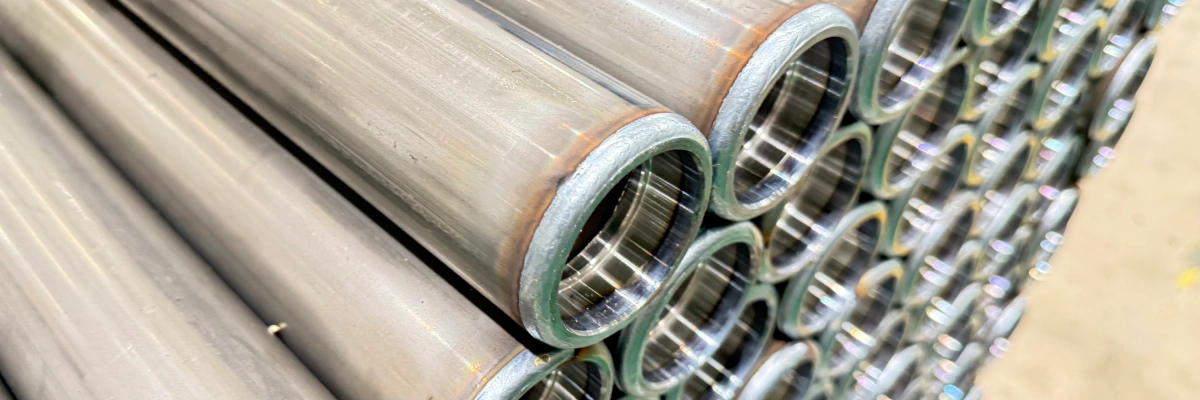
Typical characteristics of welded bearing housings include:
- Higher structural rigidity
- Strong connection with the roller tube
- Suitable for higher load conditions
Welded bearing housings are commonly used in:
- Heavy-duty conveyor rollers
- Larger diameter rollers
- Long-span conveyor rollers
In these applications, the rollers often carry heavier loads, so the structural stability of the bearing housing becomes more critical.
Plastic End Caps
Plastic end caps are another common end structure used in conveyor rollers.
They are typically manufactured through injection molding. During the molding process, the bearing installation position and structural locating features can be formed as part of the component.
In many conveyor roller designs, the shaft is not directly installed in the end cap. Instead, the shaft is installed in the inner ring of the bearing, while the end cap mainly serves to secure the bearing and provide structural positioning.
In practical manufacturing, plastic end caps are usually assembled using one of the following methods:
- Pressing the bearing into the molded end cap
- Integrating the bearing into the end cap structure
- Installing the bearing assembly after the end cap is assembled with the roller tube
Plastic end caps are commonly made from polypropylene (PP).
Plastic end caps are often used in applications where corrosion resistance, lower operating noise, or reduced structural weight are desired.
Shaft Adaptation Using Plastic Inserts
In some conveyor roller designs, additional plastic inserts may be used inside the bearing to adapt the bearing to different shaft sizes.
Bearings typically have standardized inner diameters, while roller shafts may have different sizes or shapes, such as smaller round shafts or hexagonal shafts. By inserting a molded plastic sleeve between the shaft and the bearing inner ring, the bearing can be adapted to fit different shaft dimensions.
This approach allows a standard bearing to be used with multiple shaft configurations and is a common design method in conveyor roller manufacturing.
Anti-Static Plastic End Caps
In certain conveyor applications, static electricity may accumulate during roller operation.
To reduce static buildup, anti-static additives can be added to the plastic material before the injection molding process. After molding, the plastic end caps themselves can exhibit anti-static properties.
Unlike surface treatments, this approach integrates the anti-static functionality directly into the material. As a result, the entire component can maintain stable anti-static characteristics.
In conveyor systems, these rollers are often referred to as:
- anti-static conveyor rollers
- anti-static conveyor roller end caps
Bearing Housing Comparison
The following table summarizes common bearing housing structures used in conveyor rollers.
| Structure Type | Common Materials | Typical Applications | Main Characteristics |
|---|---|---|---|
| Stamped bearing housing | Steel plate | Light- to medium-duty rollers | High production efficiency |
| Welded bearing housing | Steel | Heavy-duty rollers | High structural rigidity |
| Plastic end caps | PP | Various conveyor applications | Corrosion resistance and lower noise |
Engineering Selection Considerations
When selecting bearing housing structures for conveyor rollers, several factors are typically considered.
Load Conditions
Light-duty conveyor systems may use stamped bearing housings or plastic end caps, while higher load applications often require welded bearing housings.
Roller Length
As roller length increases, structural rigidity becomes more important. In longer rollers, welded bearing housings are often preferred.
Operating Environment
In humid or corrosive environments, plastic end caps may offer advantages due to their corrosion resistance.
Manufacturing Considerations
In conveyor roller production, the bearing housing is typically installed after the roller tube has been processed.
Different structures correspond to different manufacturing methods:
- Stamped bearing housings are mass-produced from steel sheets using stamping dies
- Welded bearing housings are machined from steel materials and then welded to the roller tube
- Plastic end caps are manufactured through injection molding processes
In many manufacturing workflows, stamped housings and plastic end caps are assembled after the roller tube surface treatment.
For welded bearing housings, the housing is usually welded to the roller tube first. The entire roller assembly may then undergo surface treatment such as zinc plating or galvanizing before the bearings are installed during final assembly.
Frequently Asked Questions
Why do pre-galvanized tube rollers use a pressed bearing housing instead of a welded one?
It is specific to pre-galvanized tube, which already carries zinc applied at the steel mill. Welding a housing onto it would burn off the zinc at the joint and leave the weld seam — the most corrosion-prone spot — unprotected, so pre-galvanized rollers use a pressed housing or plastic end cap fitted after the tube is made. Electro-galvanized (zinc-plated) and hot-dip rollers are different: the whole roller, welded housing included, is coated after assembly, so a welded housing is fine there.
Does the bearing housing or end cap seal the bearing against dust and moisture, or do I need a separate seal?
A finished LEEV roller is a sealed unit, not an open housing you add a seal to. The steel tube, bearings, and shaft are pre-assembled with seals at each end, and the bearing housing or end cap closes the tube end to keep dust and moisture off the bearing. The bearings themselves are sealed-for-life, so there is no separate external seal to specify or maintain. For dusty, humid, or washdown applications, we select the right closure and materials for the conditions.
Are plastic end caps strong enough for heavy loads, or are they only for light-duty rollers?
Plastic end caps are made from polypropylene (PP) and are intended for light-duty rollers — warehouse, gravity, and corrosion- or noise-sensitive lines where lower weight helps. For heavy loads, large-diameter tubes, long spans, or higher speeds, we use a welded steel bearing housing, because load capacity is set by the weakest end structure and steel gives the rigidity those duties need. We select the housing type to match each application.
Conclusion
Stamped bearing housings, welded bearing housings, and plastic end caps are all commonly used end structures in conveyor rollers.
Each structure provides different advantages depending on load requirements, roller dimensions, and operating environments. In practical conveyor roller design, the selection of conveyor roller bearing housing structures is typically based on a balance of structural performance, manufacturing methods, and application conditions.
These design factors are commonly evaluated during conveyor roller manufacturing and custom engineering processes.
For a complete overview of conveyor roller types and installation options, please visit our conveyor rollers page.
If you are looking for a reliable conveyor roller manufacturer or supplier, you can visit our homepage to learn more about our production capabilities, customization options, and bulk supply services.


