
Conveyor Rollers: Types, Specifications & How to Choose
We manufacture conveyor rollers to drawing and application — from light gravity rollers for flow racks to heavy-duty rollers for pallet handling. This page lines up the main roller types so you can narrow down by drive method, diameter and load, then open the category that fits for full specifications and made-to-order options.

Quality inspection and straightening during conveyor roller production — every roller is run-out tested.
Conveyor Roller Types at a Glance
Each type links to its category page for diameters, materials and custom options.
| Roller type | Drive method | Typical Ø | Best suited for |
|---|---|---|---|
| Gravity roller | Unpowered (manual / incline) | Ø25–Ø108 mm (1″–4.25″) | Flow racks, packing & sorting, carton/tote handling |
| Heavy-duty roller | Powered or gravity | Ø50–Ø108 mm (2″–4.25″) | Pallet lines, steel & automotive, high-load handling |
| Stainless steel roller | Gravity or powered | Ø25–Ø89 mm (1″–3.5″) | Wet, corrosive, hygienic, cold-storage, food |
| Plastic / PVC roller | Gravity or light powered | Ø48 · 50 · 60 mm (1.9″–2.36″) | Quiet, non-marking, clean / light handling |
| Sprocket roller | Chain via sprockets | Ø38–Ø108 mm (1.5″–4.25″) | Powered chain-driven & accumulation conveyors |
| Tapered roller | Unpowered or powered | Conical body | Curved / bend conveyor sections |
How to Choose the Right Conveyor Roller
In our production experience, four questions settle most selections:
- By drive method. No external power, with a slight incline → gravity rollers (use tapered rollers on curved sections). Belt-driven powered lines → Poly-V grooved rollers for zero-pressure accumulation. Higher-load chain-driven lines → sprocket rollers.
- By load. There is no single load rating — capacity depends on tube diameter and wall thickness, shaft, bearing and support span, and most rollers are built to the application. Tell us the load per roller and the span, and we size the tube, wall, shaft and bearing to suit. As a rule of thumb, larger diameters and thicker walls carry more.
- By environment. Dry / standard → zinc-plated steel. Wet, corrosive, hygienic or cold-storage → stainless steel (201 / 304 / 316). Quiet, non-marking, light duty → plastic / PVC.
- By conveyor geometry. Straight runs → standard cylindrical rollers. Curves and bends → tapered rollers, which keep cartons tracking to the inside radius.
Anatomy of a Conveyor Roller
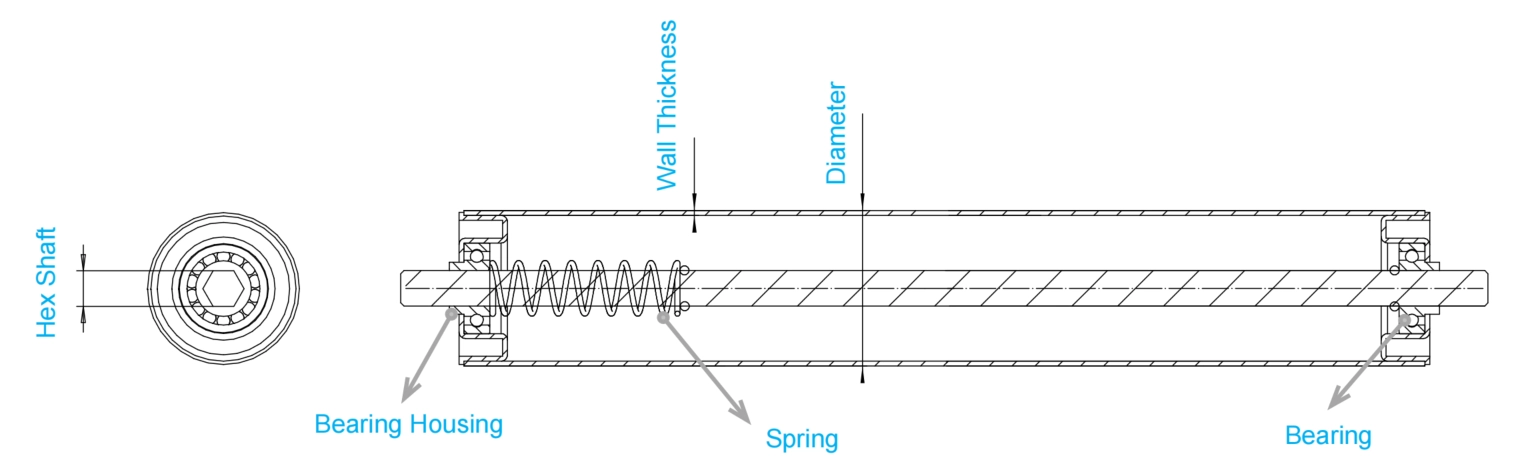
Cross-section of a standard LEEV conveyor roller. Diameter, wall thickness, shaft type and bearing are built to your drawing.
A conveyor roller is a precision-machined tube turning on bearings around a shaft. Bearing choice, bearing-housing fit and seal type decide how quietly and how long a roller runs under load and contamination.
Diameters & Specifications We Manufacture
| Tube diameter | Ø25–Ø108 mm (1.0″–4.25″), or custom |
| Tube material | Carbon steel · galvanized · stainless 201/304/316 · PVC |
| Wall thickness | 1.2 · 1.5 · 2.0 · 2.5 · 3.0 · 3.5 mm, or custom |
| Roller face length | 70 mm – 6 m |
| Shaft / end type | spring-loaded · internal/external thread · hex · flat · through-shaft, or custom |
| Shaft / bore size | round Ø8 · 10 · 12 · 15 · 20 · 25 · 30 mm; hex 11 mm (7/16″) & 17.5 mm (11/16″); or custom |
| Bearing | Deep-groove ball bearing, or custom |
| Surface finish | zinc · galvanized · nickel-plated · chrome-plated · PVC sleeve · PU sleeve (slip-on) · cast-on PU coating |
| Operating temperature | −30 °C to 120 °C (low / high-temp builds on request) |
| Run-out (TIR) | ≤ 0.5 mm/m, 100% inspected |
 | ISO 9001:2015 certified — certificate no. 04625Q13002R2S
All rollers are custom-made by our conveyor roller factory. |
Conveyor Roller FAQ
Gravity vs powered conveyor rollers — which do I need?
If your line slopes slightly or product is pushed by hand, gravity rollers move goods without power and cost least. For controlled, level or uphill movement, choose powered rollers — Poly-V (belt) for light accumulation, sprocket (chain) for heavier loads.
What roller diameter for pallets vs cartons?
As a general guide, cartons and totes run on Ø38–Ø60 mm (1.5″–2.36″) rollers, and pallets and heavy unit loads on Ø76–Ø108 mm (3″–4.25″). The exact choice depends on load per roller and span, so we size each roller to the application.
Which rollers for wet or cold-storage lines?
Stainless steel (304 / 316) for wash-down, corrosive or hygienic areas. Our rollers run from −30 °C to 120 °C as standard, with special low- or high-temperature builds on request.
Can you make rollers to my drawing?
Yes — we adjust diameter, face length, shaft end, bearing and surface finish to your specification. Send a drawing or sample for a quote.


