
In certain industries, products must be processed, stored, and transported in low-temperature environments. Typical applications include vegetables, fruits, perishable agricultural products, ice cream, frozen beverages, quick-frozen foods, meat, seafood, biological products, and pharmaceuticals.
Conveyor rollers used in these environments are commonly referred to as low-temperature conveyor rollers.
Common Temperature Ranges in Cold Chain Applications
Different cold storage processes operate at different temperature levels:
-
Fresh storage: +5°C to -2°C
-
Refrigerated storage: 0°C to -15°C
-
Frozen storage: -18°C to -25°C
-
Quick-freezing: -35°C to -40°C
-
Ultra-low temperature storage: around -45°C
For fresh storage, standard conveyor rollers are usually sufficient.
As the temperature decreases, however, the effects of low temperature on roller materials, bearings, and lubrication must be carefully considered.
Material Selection for Low-Temperature Conveyor Rollers
Avoid Plastic Components at Low Temperatures
Plastic components are generally not recommended for low-temperature environments. Long-term exposure to cold can cause plastic materials to become brittle, leading to reduced service life and unreliable operation.
Steel vs. Stainless Steel Rollers
Roller material should be selected based on the actual operating environment, especially where corrosion is a concern:
-
Steel rollers are suitable when contact with liquids is limited
-
Stainless steel rollers are recommended for environments involving:
-
Acidic or alkaline conditions
-
Salt spray or high humidity
-
Frequent cleaning or washdown
-
When carbon steel rollers are used, appropriate surface protection and low-temperature-compatible bearing lubrication are essential.
Bearing Lubrication in Low-Temperature Environments
Bearings are one of the most critical components of low-temperature conveyor rollers.
In cold environments:
-
Standard grease becomes more viscous as temperature decreases
-
Reduced grease flow increases bearing resistance
-
Roller rotation slows down, increasing wear
At lower temperatures, ordinary grease may partially or fully solidify, which can result in:
-
Unstable or difficult roller rotation
-
Increased vibration
-
Abnormal operating noise
Low-Temperature Resistant Grease and Bearings
Low-temperature conveyor rollers require grease specifically designed for sub-zero operation.
Typical low-temperature grease used in these applications supports an operating range of:
-
+120°C to -50°C
This allows conveyor rollers to maintain:
-
Smooth bearing rotation
-
Stable performance
-
Reliable operation in cold storage and freezing environments
Ultra-low temperature applications below -50°C require specially designed bearing and lubrication solutions.
Sealing Design Considerations
Effective sealing helps prevent:
-
Moisture ingress
-
Ice formation inside bearings
-
Premature bearing failure
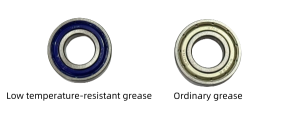
Clear differentiation between low-temperature bearings and standard bearings during production also helps ensure correct component selection and consistent product quality.
Conclusion
Low-temperature conveyor rollers must be selected based on actual operating temperature, environmental conditions, and system requirements.
Material choice, bearing design, lubrication performance, and sealing structure all play a critical role in ensuring reliable conveyor operation in cold storage and cold chain systems.
Careful selection and proper configuration can significantly improve service life, operational stability, and overall system efficiency in low-temperature applications.
Looking for customized conveyor rollers or bulk manufacturing?
Visit our conveyor roller manufacturing page for more details.


